|
|
|


Characteristics
Sorbic Acid
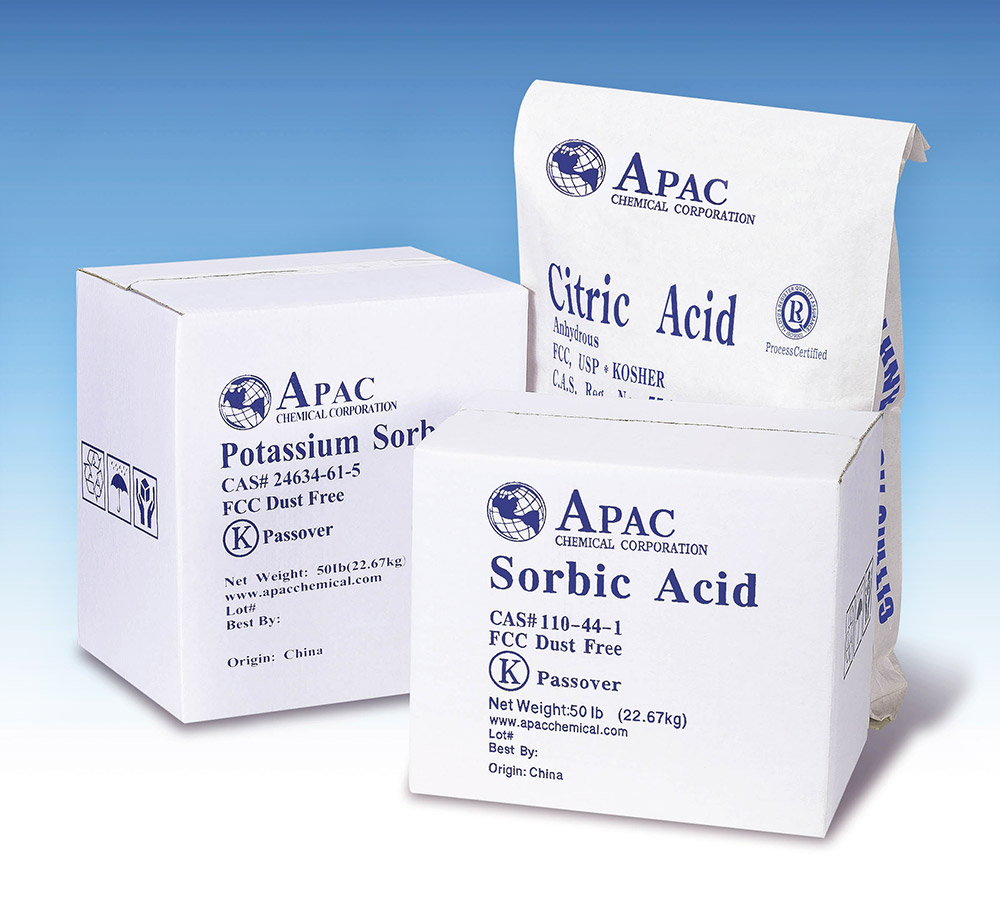
appears as white,
free flowing crystalline granules with a mild and characteristic odor. It
is slightly soluble in water, and completely soluble in alcohol.
Sorbic Acid Kosher Passover Certified

Potassium Sorbate
appears as white, free flowing, extruded pellets or spherical beads with a
mild and characteristic odor. It is very soluble in water, and slightly
soluble in alcohol.
Potassium Sorbate Kosher Passover Certified

APAC
's
sorbates meets FCC
IV specification; and
is available in granular, powdered, and pellet form.
Packaging
APAC
's
sorbic
acid and potassium sorbate are packed in U.S. standard, 50 lb. recyclable
white corrugated cardboard boxes with polyethylene inner lining.
Storage
Sorbic acid and potassium
sorbate should be stored in a cool, dry area away from direct sunlight and
heat or moisture. Re-close original packaging or containers after each use
to prevent moisture absorption.
Sorbates
Food Preservatives
(Click on any of the links below for details)
Sorbates Advantage
Sorbic
acid
and it's more soluble potassium salt,
potassium sorbate are
among the safest and most efficient, versatile food preservatives used
today. In addition, Sorbate preservatives:
Are highly effective inhibitors of most common microorganism types that can
attack foods.
Are a naturally occurring polyunsaturated fatty acid, which is completely
metabolized.
Do not affect taste,
color, or flavor of foods.
Are very effective over a
wide range of pH.
Effect
of pH
When used at the pH
levels of most mildly acidic food products (pH 5.5-6.0), Sorbates are the
most effective preservatives against a wider spectrum of food spoilage
microorganisms than benzoates or propionates. Sorbate efficacy increases
with greater acidity. Above pH 4.0, Sorbates are more effective than sodium
benzoate and sodium or calcium propionate. At pH2.5 to 3.0 sorbate are still
somewhat more effective than sodium benzoate as yeast and mold inhibitor and
more than twice as potent as propionates. Sorbates are at their optimum
effectiveness used below pH6.0. They function, however, up to pH6.5 but are
relatively ineffective at pH7.0 and above.
Effect of
Temperature
The growth
of most micro-organisms is fostered by mildly warm
temperatures. Consequently, adequate preservation must take this into
account. A food product that can be sterilized when packed and distributed
for open shelf display may still require refrigeration plus a preservative
if its use by the consumer is protracted. Even for refrigerated products,
the potential for increased microorganism inhibition makes the use of a
Sorbate preservative advisable.
Influence of Sanitation Upon Freshness & Keeping Quality
Three essential factors
in protecting food from microbial degradation are the initial freshness,
freedom from contamination and sanitary handling in the product's
preparation and packaging. Controlling the number of spoilage organisms in
food products at the outset- from ingredients through processing must be
the foundation for long-term preservation. Sorbates can slow microbial
spoilage if a product has a moderate microorganism population up to a
point. The initial contamination from unsanitary handling or from degraded
ingredients can be too high for effective growth inhibition and spoilage can
be rapid, almost as though no preservative were used. While Sorbates will
act effectively to maintain freshness longer, the preservative will not mask
poor quality or contract unsanitary handling.
The
factors that affect the selection of a preservative and level of use are:
- Moisture
Content
- Presence
of other inhibitors (salt, sugar, spices, smoke)
- pH of
the product
-
Processing sanitation ingredients, equipment, premises
- Length
of storage
-
Packaging
-
Frequency of consumer use and use life
-
Temperature of Storage
Types
of Food Protected
In
general, sorbates may be used in any kind of food product which allows
preservatives from the GRAS (Generally Recognized As Safe) list of food
additives. Sorbates may also be used at the levels specified in some 70 or
more food products having a Standard of Identity.
The following are
the various kinds of foods and processed products that can be kept fresher
longer by the proper use of sorbate preservatives.
Natural Cheese (all kinds, surface treatment)
Processed Cheese (all kinds)
Cottage Cheese
Sour Cream- Type Products
Cheese Spreads & Dips
Yogurt
Cakes & Cake
Mixes
Pies & Pie
fillings
Doughnuts
Baking Mixes
Fudges & Icings
Fruits-Filled
Toaster Pop-Ups
Yeast Leaved
Baked Goods (Surface)
Wine
Jams & Jellies
Artificially
Sweetened Confections
Orange Juice &
Fruit Drinks
Dried Fruit,
Prunes & Raisins
Packaged fresh
salads
Pickles & olives
Relished
Dry sausage
casings
Low-cal diet
drinks
Semi-moist pet
foods
Mayonnaise
Salad dressings
The amount of sorbate (acid or salt) used must
be determined by the food processor on technological and economic bases.
As a rough guide, the following are the ranges of usage levels for products,
which can be considered as typical of those in the particular category.

Product
|
Typical Use
Level (%)
|
Cheese and Cheese Products
|
0.2 - 0.3
|
Fruit Drinks
|
0.025 - 0.075
|
Beverage Syrups
|
0.1
|
Cider
|
0.05 - 0.1
|
Wine
|
0.02 - 0.04
|
Cakes And Icings
|
0.05 - 0.1
|
Pie Fillings
|
0.05 - 0.1
|
Margarine (Unsalted)
|
0.1
|
Prepared Vegetable Salads
|
0.02 - 0.1
|
Dried Fruits
|
0.02 - 0.05
|
Semi-Moist Pet Food
|
0.1 - 0.3
|
Salad Dressings (Pour-Type)
|
0.05 - 0.1
|
Sorbate preservatives can be applied by a
variety of methods selected on the basis of processing convenience and type
of food product. There are five common methods:
Direct addition into
the product
Dipping
Spraying
Dusting
Incorporation in the
wrapping
Preparation of
Sorbates Spray or Dip Solutions
Desired
Concentration of
Potassium Sorbate
Spray or Dip
(percent)
|
50% Stock Solution
of Potassium Sorbate (units)
|
Added to Water
(units)
|
20
|
0.4
|
0.6
|
25
|
0.5
|
0.5
|
30
|
0.6
|
0.4
|
35
|
0.7
|
0.3
|
40
|
0.8
|
0.2
|
Percent (%)
Stock Solution
Desired
|
Potassium Sorbate
(lb.)
|
Water (Fl.Oz.)
|
10
|
1.0
|
139
|
15
|
1.5
|
131
|
20
|
2.0
|
123
|
25
|
2.5
|
116
|
30
|
3.0
|
108
|
40
|
4.0
|
92
|
50
|
5.0
|
77
|

Sorbic
acid and potassium sorbate are GRAS (Generally Recognized As Safe) for use
in foods.
Sorbic
acid and
potassium sorbate have been cleared for use and approved as food
preservatives by the U.S. food & Drug Administration. The clearance was
based upon extensive laboratory testing and their safety has been
subsequently supported by the results of worldwide studies and usage as a
food additive/preservative since 1955.
|